

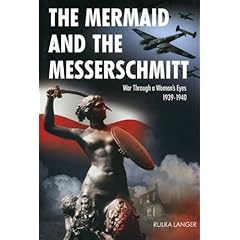
Rare eyewitness account of early, chaotic days of WWII - Nazi invasion of Poland, Siege of Warsaw and first months of Occupation - written by a young working mother. Rulka Langer's eye for detail and lively storytelling bring to life, from her unique vantage point, the opening chapter of the struggle between good and evil which ultimately engulfed the entire globe.
| |||||||||||||||
Book Description
Frequently Bought Together

Editorial Reviews
Review
September 1, 1939 is an infamous day in 20th Century history, the start of World War II. But how many of us today know what happened when Nazi Germany invaded Poland, unleashing its military furor for the first time?
Seventy years later, a new edition of The Mermaid and the Messerschmitt...does what no other book has done.
...Rulka Langer's story is utterly contemporary and compelling, and once I started the book, I could not put it down until I finished it.
...That summer, everything in Europe revolved around talk of war. Rulka read Margaret Mitchell's Gone With the Wind, and with a heavy heart pondered the fate of Poland caught between Nazi Germany and Stalinist Russia. Would it be gone with the wind?
But nothing could prepare her or anyone who lived through the blitzkrieg and the war that followed. The destruction was shockingly fast and Rulka describes it day by day, each day that seems like weeks - the bombs, the bomb shelters, the fires, the scarcity of food, horse carcasses in the street stripped to the bone by hungry people, so many deaths that people were buried in empty lots all over the city, refugees from border towns coming to Warsaw, Varsovians escaping the city for points further east, the evacuation of the leaders and of the Bank of Poland, the personal horrors of women and children trying to survive.
Rulka published her book in 1942, after arriving in the United States, before the U.S. entered the war, before anyone knew how long the war would last and how it would be resolved, and before the horrors of the concentration camps and the Nazi genocide of Jews, gypsies and others would be revealed.
Able to get a U.S. visa because of her husband's position [as a Polish diplomat posted in the U.S.], she and her children escape the Nazi occupation in February 1940 by train, from Warsaw to Cracow to Vienna to Genoa for a boat to the U.S. The train is filled with German soldiers.
In a surreal moment at the end of the book, a soldier who is on leave and going skiing in Italy, befriends Rulka. Rulka tells him that she will be coming back to Poland as soon as it is free. He replies, well, Poland will be free of Jews. When she says that she doesn't care about that because she likes the Jews, he retorts that no one likes the Jews.
And then, bravely, Rulka asks him about the many German military uniforms, brown, gray, black, green, and wonders which is the Gestapo uniform because whenever people were beaten in Warsaw, everyone said, it's the Gestapo. The young soldier laughed. You want to know what the Gestapo uniform looks like; then look here and he pointed to the SD on his sleeve. This is the Gestapo uniform.
In Rulka's compelling story, we walk in her footsteps and the past is present.
--Fontayne Holmes, City Librarian, Los Angeles Public Library, 2004-2008
An unusual take on WWII ... a rare eyewitness account of the war's early, chaotic days--the Nazi invasion of Poland, the Siege of Warsaw and the first few months of Nazi occupation--written by Rulka Langer, a civilian, a young Polish career woman and mother and a graduate of Vassar College. --Publishers Weekly, August 24, 2009, at p. 35
"The narrative is so exquisitely rendered, built as it is upon a mountain of sharply observed details and trenchant insights into human nature, I could not put it down....One of the gifts of Langer's narrative is her unsparing, truthful description of herself and others." -- Wanda Urbanska, host & producer of the PBS TV show "Simple Living"
Anyone who's ever read memoirs written during or immediately after the war knows how very different they are from those written many years later. The writing is vivid, unembellished, adrenalin charged. Memories have not yet faded, been tampered with. There is no editorializing. War is an experience unlike any other. Nobody comes out of it unchanged. When these experiences are recorded by gifted writers - and Rulka Langer certainly was that -- they are at once harrowing, inspiring and breathtaking.
Rulka Langer's The Mermaid and the Messerschmitt was first published in 1942, just months after she escaped with her two children from Warsaw, leaving behind her mother, friends and, although she didn't realize it yet, a life that could never again be restored...
When the war started, Rulka, like many of her fellow Varsovians, was confident. The Poles would stop the Germans; the British and French will help. But the news from the front was grim. The Polish army couldn't hold back the invading Germans whose tanks and planes targeted peaceful villages, residential areas and unarmed civilians as fiercely as they did military targets. The allies did not show up; instead, the Red Army joined the Germans and attacked from the east.
In a gripping, fast-paced narrative, Langer describes the anticipation and dread, the panic and confusion, people in motion - to escape the bombing of the city; to escape the burning of peaceful villages and the strafing of civilians on the run; refugees laden down with possessions; refugees forced out of homes with nothing...
Langer describes the devastation of the city but she writes primarily about people. People in their infinite variety, with their infinite ability to surprise. Only the very naïve would try to predict their own behavior in a crisis. She witnessed heroism in people she had always considered timid, and cowardice among people who, before the war, had flaunted their boldness.
Langer didn't spare herself. She was dismayed by her own response to hunger. Under extreme conditions, she who had been critical of looters suddenly found herself looting a bombed out house to get essential articles for her own family. In an unexpected bombardment she fled so quickly that she had forgotten about her own mother.
When the siege ended and the occupation began, the enemy that until then was an impersonal machine in the air was now seen face to face. Terrifying as the bombs were, the sight of a uniformed soldier beating young men, arresting women, shouting, shoving and humiliating people you knew, evicting and dispossessing your neighbors, these acts tore at the heart as acts of cruelty took on a personal character.
Langer's book takes you to the centre of the drama, not just the way a war correspondent would, she explained, because a war correspondent, when reporting on a bombed city, "doesn't leave his children behind in his hotel room... nor tremble for the life of his own mother... and it isn't his own house that has been set on fire by the incendiary."
"The horrors of war," she writes, "come pretty much like the pangs of childbirth. At first, in spite of apprehensions, life still goes on, almost normal, with all its little trivialities. Then comes the pang: wild, screaming, inhuman. You think you'll never stand it - yet you do. It passes - once more you are yourself. Trivialities reappear." And so it goes, another and another. People die, and people are born. And no one will ever be the same again. -- Cosmopolitan Review, December 2009
World War II started on September 1, 1939, when German troops and warplanes launched their assault on Poland... Langer, a working housewife with two children, was in the city waiting for an opportunity to join her husband Olgierd, who was working for the Polish Ministry of Foreign Affairs in Philadelphia. Her description of the blitz, the siege, and the occupation is personal, moving, laced with grim humor, and accessible to a modern audience... This edition has added more than 100 black-and-white photos and maps, explanatory footnotes, a timeline, and an epilogue by Langer's son George. -- College & Research Libraries News, December 2009, published by the Association of College & Research Libraries
"It is absolutely one of the best eye-witness accounts of WWII Poland that I ever read." -- Alan Furst, author of The Foreign Correspondent and The Spies of Warsaw
From the Publisher
On the 70th anniversary of the beginning of WWII (Sept. 1, 1939), we are very proud and excited to present our new edition of The Mermaid and the Messerschmitt.
We spent more than a year researching and licensing the photos and other illustrations from many sources in the U.S., U.K. and Poland to include in our edition -- we wanted our visuals to really illuminate and enrich the story. We will also offer to purchasers of our edition a copy of the rare 1940 Academy Award-nominated 10-minute newsreel Siege, consisting of original footage of the Siege of Warsaw shot by American photojournalist Julien Bryan, the last neutral journalist remaining in Warsaw during September 1939.
We're sure that if you're interested in knowing more about WWII, the civilian experience of modern war, and/or seeing war through different eyes, you'll love this book!
Thanks for your interest!
Aquila Polonica Publishing
Product Details
Would you like to update product info or give feedback on images?
|
Customer Reviews
|
Share your thoughts with other customers:
|
||||||||||||||||||||||
|
Most Helpful Customer Reviews
8 of 8 people found the following review helpful:
5.0 out of 5 stars
A Rip-Roaring Page Turner that is also Profound -- In a Word: Wow!,
By
This review is from: The Mermaid and the Messerschmitt: War Through a Woman's Eyes, 1939-1940 (Hardcover)
Rulka Langer's "The Mermaid and the Messerschmitt" is a rip-roaring page-turner, easy to read, spine-tingling, and entertaining. It is also deeply profound. I'm going to buttonhole friends, insisting that they read it; I'll buy copies to give as gifts. "The Mermaid" is not just as delicious to read as a mass market bestseller. It is also essential reading on vital questions of what it means to be a human being, what war is like on a day-to-day basis, and how the Holocaust happened.
Rulka Langer, the heroine and author of "Mermaid," is very much like Katharine Hepburn, the Golden-Age, Hollywood film star. Langer is beautiful, brisk, no-nonsense, and a born heroine. Her very likable presence accompanies the reader through what would otherwise be unbearable scenes. "Mermaid" is so vivid, so cinematic in its details, that I kept seeing it as a Hollywood film. Langer is a young wife, mother and Vassar grad living in Poland in 1939. Her grandfather was a landed nobleman. Her focus in life is her proud and loving family, parties, fashion, thoroughbred horses, and her fun job for an American advertising firm. In many ways, Langer is very much like a potential American reader for this book - someone who has no idea that within days of a pleasant summer picnic she will confront the greatest evil the world has ever known in her own home - and that the only weapon she will wield in that confrontation is her own sense of honor. World War Two began in Poland, when, on September 1, 1939, Nazi Germany invaded. The Holocaust would take place largely in Poland. The book opens with sprightly, appealing scenes of Langer's family. You get to like Langer, her brother, her mother, and her children, the characters who will be with you throughout the book. Langer's quick yet detailed style shines in a delightful description of the pleasures of traveling by a horse-drawn carriage through the Polish countryside. You feel as if you are next to Langer as she observes a peasant woman in a red kerchief, and a little black dog, as she calls out, "God's blessings," and field laborers answer back, "May the Lord give it." You wonder, though - is this author a frivolous woman? Will she really be able to write about the German carpet bombing of Polish civilians? Never fear, reader. She will. She will. In that late Polish summer, straws appear in the wind: rumors of invasion by Nazi Germany. At first, Langer's greatest concern is that Hitler's plans will interfere with her summer vacation. One of the truly stunning strengths of "Mermaid" is its style. Langer's writing is vivid, immediate and frank. It's as if you are her best friend and it's 1939 and you are reading telegraphic updates. Though Langer wrote this book after she'd found safety in America, she doesn't exploit the luxury of hindsight to manage her image, or to make herself out to have been a prescient student of world history fully prepared for blitzkrieg. "Mermaid" offers a time capsule of world historical events as those events were happening. World War Two and the Holocaust are so vast and so evil that their narrative management is a full time obsession. Today, vocabulary guardians debate whether or not Polish Catholic concentration camp inmates can be said to have been victims of "The Holocaust." Langer wrote her book while World War Two was still occurring, before its immensity had been grasped. She offers a raw, eyewitness view of history's minute-by-minute unfolding, before the narrative managers arrived on the scene. She tells us that September 1, 1939 (like one September 11, decades later), was a frustratingly beautiful late summer day. Langer devotes the same brisk, vivid sentences to descriptions of starving people butchering horses on Warsaw streets that she had previously devoted to describing her handsome husband. Langer's style does not change even after, in search of provisions to feed her starving children, she traverses bombed streets flooded with the human blood of her fellow Varsovians, even after Nazis literally walk into her home as she is undressing. You realize that her previous descriptions of leisurely family life were not the fruit of her trivial nature or her sheltered existence. Rather, you realize that Langer's ability to pen a loving, detailed description of the pleasures of carriage rides in the country is the product of supreme self-discipline. This author has been to hell and back. Her aristocratic pose is her heroic resistance to the enemies of civilization. Langer's descriptions of the madness of war are unforgettable. A seal escapes from the zoo ... a man takes over an apartment complex and demands that all pet dogs be shot ... beautiful young heroes and heroines materialize from the blood, smoke, and chaos, bond, and are snuffed out ... mothers silently resent going without food in order that children be fed. The Nazis' genocidal plans twist Poles' lives. Evil rumors turn Pole against Pole. Every time resisters kill a German, dozens of Poles are killed in retaliation. A girl is executed for defacing a Nazi propaganda poster. In recent years, there has been a scholarly and media effort to shift blame for the Holocaust from German Nazis to Poles. Poles, it is said, did not do enough to help Jews during the 1943 Warsaw Ghetto Uprising. Gunnar S. Paulsson's "Secret City" is an antidote to such talk, but so is "Mermaid." Langer, a survivor, makes excruciatingly clear how the Nazis terrorized all Poles, paving the way for Nazism's heinous crimes against Jews. Part of what makes this book bearable is its "happy ending." The reader knows that Langer will get out of Nazi-occupied Warsaw and write and publish this book. Langer's escape is similar to that of Maria von Trapp of "Sound of Music" fame; in fact, von Trapp and Langer became friends. Others of Langer's family and friends were not so fortunate. For example, Langer's husband's father, her children's grandfather, was Jew. He was beaten to death. Secret City: The Hidden Jews of Warsaw, 1940-1945 Bieganski: The Brute Polak Stereotype in Polish-Jewish Relations and American Popular Culture (Jews of Poland)
5 of 5 people found the following review helpful:
5.0 out of 5 stars
Survival in War-torn Warsaw Makes for Inspiring Reading,
By
This review is from: The Mermaid and the Messerschmitt: War Through a Woman's Eyes, 1939-1940 (Hardcover)
This rare eyewitness account of the early, chaotic days of World War II stretching from the relatively halcyon days prior to the onset of World War II, through the Nazi invasion of Poland on September 1, 1939, and the siege of Warsaw to the first few months of the Nazi occupation is told from the perspective of a young working mother. The book has already scooped the 2010 Benjamin Franklin Silver Award in the nonfiction category of the Bill Fisher Award for Best First Book, as well as being a selection of the Book-of-the-Month Club, the History Book Club, and the Military Book Club. This second edition of the work includes over 100 black-and-white photos, maps and illustrations (some never before published) and other supplemental material not included in the original, which was published in 1942.
Rulka Langer came from a family of distinguished Polish intellectuals, writers and statesmen. After surviving the first five months of the war in Poland, Rulka fled the Nazi-occupied country together with her young son and daughter, aged 8 and 3, in early 1940 to join her husband, who was at that time a member of the Polish diplomatic corps posted in the United States. Having a background in political and economic writing, as well as in research for the Bank of Poland, she soon became a popular lecturer, writing The Mermaid (the official symbol of Warsaw) and the Messerschmitt in 1942 in an attempt to explain to Americans the devastation wrought by the War for ordinary human beings caught up in it. Written from a young fashion-conscious woman's angle, it is all the more poignant, as it reveals how the average civilian had their world literally dug up from under their feet by the unexpectedness of the onslaught of one of the mightiest forces that has ever besieged Europe. Who can, for example, forget Rulka's initial embarrassment, on first volunteering for air raid shelter digging: "I felt rather silly with my high heel shoes, a pert hat cocked over my right eye, and a spade on my shoulder. I was also at a loss how to handle my red handbag and gloves." Soon all personal concerns are lost, though, as Rulka becomes caught up in the heroic, though relatively short-lived, attempt made by the Varsovians to defend their city from the invading militaristic might of one of the cruelest powers ever to dominate large portions of Europe. All those who enjoyed the adventures of the von Trapp family in The Sound of Music are likely to enjoy Langer's writing, which has much in common with the former work, in terms of descriptions of loving relationships and noble deeds of outwitting the enemy despite all odds. Although there are undertones of the savagery and brutality of the war, these are not the major concern of the work, which is generally upbeat in tone, telling more about the daily trials and tribulations experienced by those living in an urban environment under siege. A wonderful, heart-warming read, which, nevertheless, does not try to cover up the harshness of the conditions to which the average civilian was subjected during World War II. [Reviewer for BookPleasures.com]
5 of 5 people found the following review helpful:
5.0 out of 5 stars
The Mermaid and the Messerschmitt,
By
Amazon Verified Purchase(What's this?)
This review is from: The Mermaid and the Messerschmitt: War Through a Woman's Eyes, 1939-1940 (Hardcover)
This is a very readable account of the terrible invasion of Poland in first year of World War II, told from a very unusual perspective. It is packed with information and presented with feeling that can only come from having lived through the invasion. The description of the destruction caused by the German bombing and the cannon fire were brought to life with the photographs. I recommend the book, written from a woman's perspective, to anyone with an interest in Poland and the war.
Share your thoughts with other customers: Create your own review
|
|
What Other Items Do Customers Buy After Viewing This Item?


Tags Customers Associate with This Product(What's this?)Click on a tag to find related items, discussions, and people.
|
Sell a Digital Version of This Book in the Kindle Store
If you are a publisher or author and hold the digital rights to a book, you can sell a digital version of it in our Kindle Store.
Learn more
Customer Discussions
|
This product's forum
Active discussions in related forums
Search Customer Discussions
|
Related forums
|
Listmania!
|
|


